How AI is helping us work smarter—while introducing new uncertainty about what comes next.
AI is both a blessing and a curse. On one hand, it has made me more productive, more capable, and more efficient than I’ve ever been. On the other hand, it’s introducing a level of uncertainty that none of us can ignore.
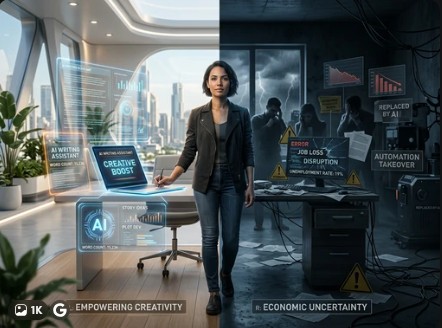
AI has made me more productive and capable—but it also raises
important questions about where we’re headed.
The Good
I’ll start with the positive—because there’s a lot of it. AI has helped me in several practical ways:
-
Setting up and improving my author website (RaymondJMills.com)
Anyone who has built a website from scratch knows it can take days—and sometimes be frustrating as hell. I’m comfortable with HTML and CSS, but was a bit rusty, and I didn’t want one of those out-of-the-box, vanilla sites. AI helped bridge that gap. You can see it here -
Solving technical issues
I’ve run into OAuth issues in Outlook—something Microsoft recently addressed in a newer release. With a combination of ChatGPT and persistence, I was able to resolve the issue without losing my mind (or smashing the computer). -
Editing and refining my writing
Tools like ProWritingAid have been a godsend. They help me clean up awkward sentences, and I’ve actually gotten better at using commas along the way. -
Brainstorming ideas and organizing thoughts
I don’t work alone anymore. I have a trusted assistant I can bounce ideas off—someone to ask, “Does this make sense?” or “Does this sound reasonable?” -
Personal finance and investing
My unofficial investing club has used AI to speed our exploration potential dividend stock and ETF investing strategies. - Improving my Excel and VBA-focused website to better serve potential clients AI helped me look at my site from a client’s perspective—making it clearer, more useful, and more aligned with what people are actually looking for when they need Excel and Access solutions. You can see it here
In short, AI has made me better at what I do. It’s not replacing the work—it’s enhancing it.
For someone who writes, builds, and creates, that’s powerful.
Ultimately, AI doesn’t make me smarter—it acts as a tool that helps me be less wrong.
The Bad and the Ugly
But it would be dishonest to ignore the other side.
AI is also reshaping the job market in ways that are hard to predict.
- Roles are changing—fast. Many people are understandable fearful of this. For example, I am a member of one of the largest writer groups on facebook. There was a while there where any mention of AI would get your post pulled. Along with a good many nasty comments. The insanity of pretending something isnt happening or that you could quell AI by not discussing seemed counter to what writers are about "open expression".
- Some jobs have and will continue to disappear
- AI could automate 30% of U.S. jobs by 2030.
- 60% of jobs will have significant task changes due to AI.
- AI could displace up to 300 million jobs globally.
- Others will evolve into something entirely different
-
The old model—solve a problem → rank in Google → get contacted—has been fundamentally disrupted.
- This shift hit me in a big way. I’m actively rewriting my website to adapt to this new model—because clicks, well… they’re becoming a thing of the past.
- AI is keeping users from ever visiting your site, with ~60% of searches ending without a click.
- When AI summaries appear, click-through rates can drop by up to 80%.
- Even when you rank, your link may be pushed far below AI-generated answers.
- AI-driven traffic is still minimal (often under 1%), meaning it isn’t replacing lost traffic.
- You can publish helpful content like “How to fix X in Excel”… and the user gets the answer without ever needing you.
And that creates uncertainty. Not just for employees—but for freelancers, writers, developers, and creators who have built careers on skills that are now being automated or augmented. The pace of change is what makes this feel different.
It’s not a gradual shift—it’s a disruption.
Final Thoughts
AI is a tool that amplifies what you already are.If you’re engaged, curious, and willing to adapt—it can make you better.
If not—it can leave you behind. If you are worried I suggest you read my post:
Use Your Downtime To Protect Your Career
Like any powerful tool, it’s not just about what it can do. It’s about how we choose to use it.
More Articles You Might Enjoy
If you enjoyed this article, you may also like:
- Retirement Is Not the End — It’s the Beginning of a New Lifestyle
- The Corporate Worker’s Survival Guide (38 Years of Lessons)
- Investing Smarter: How Low-Cost Index Funds Can Outperform Fees and Guesswork
- How NYC Is Following Detroit’s Path: Urban Decline NYC Lessons from the Late ’80s
- Use Your Downtime To Protect Your Career
- The Illusion of “Cheap Debt”
- The Tipping Culture’s New Twist
- AI: A Blessing and a Curse