It’s interesting how many of my friends who worked in investment banking for over ten years still “have a guy” or “a gal” managing their investments — even friends who are CPAs. I understand it. For some people, investing simply isn’t interesting. Their eyes glaze over when the conversation turns to markets or portfolio construction. For them, delegating that responsibility makes sense, and there’s real value in having a trusted advisor if it gives them peace of mind and keeps them disciplined.
Vanguard Funds are a favorite of mine
As someone with an MBA in Finance, an MS in Tax, and a fondness for spreadsheets (I’m an MS Office developer), I don’t really have that excuse. I actually enjoy this stuff.
Fotunatley, Investing successfully doesn’t require predicting the market or chasing the latest hot stock. In fact, many investors achieve better long-term results through low-cost index funds, a simple passive investing strategy that minimizes fees and removes the guesswork from investing. By focusing on diversification and keeping costs low, index fund investing allows the market’s long-term growth to work in your favor.
My core beliefs are fairly straightforward: most professional investors do not consistently beat the S&P 500 over long periods. After fees and taxes, the percentage who outperform drops even further. The longer the time horizon — 10, 20 years or more — the fewer active managers remain ahead. So why not simply buy, for example, a low-cost Vanguard S&P 500 index fund? They charge just 0.03% in fees.
Why Low-Cost Index Funds Often Beat Expensive Active Funds
As for exceptionally gifted investors like Warren Buffett, I try to follow their principles rather than attempt to replicate their stock-picking. Buffett famously said, “By periodically investing in an index fund … the know-nothing investor can actually outperform most investment professionals.” I find that perspective both humbling and practical.
In my experience, discipline, low costs, and long-term consistency matter far more than trying to outguess the market.
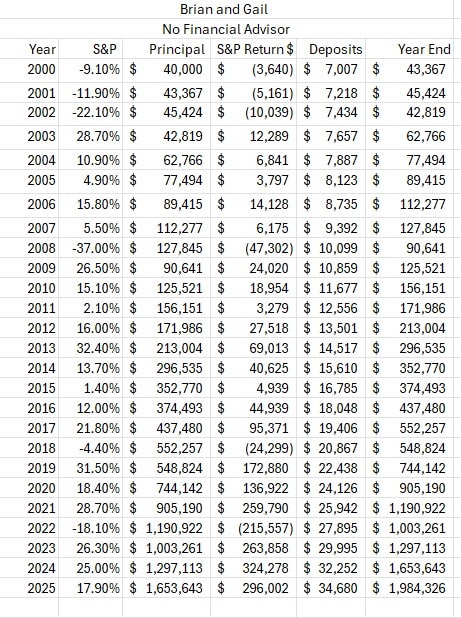
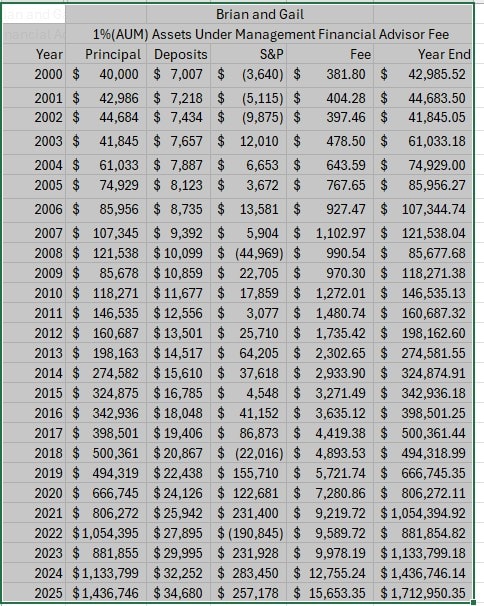
In the charts above I’ve loosely modeled the investment lives of some friends, Brian and Gale X. Some years ago, Brian had a windfall, and I helped him invest; they don’t use a financial advisor (FA). My second chart models what would have happened if they had used an FA. Spoiler alert: over 25 years of investing, using an FA would have cost them over $100K in fees, and their FA-guided portfolio would have underperformed the non-FA portfolio by $271,000. Brian and Gale are an average family — $271K is a significant amount of money.
The Hidden Cost of Investment Fees and Market Guesswork
Finally, people have strong opinions about money, and that’s fine. How you choose to invest — whether to use a financial advisor or not — is up to you. I am focused on the numbers. Personally, being judicious and mindful about spending has served me well. Oh, and one more thing: a 12% savings rate is too low.I’m happy to hear your thoughts — and, as always, please keep them kind and on point.

Join My Reader List
A few short posts each month about writing, new releases, and behind-the-scenes notes from my projects.
I never share email addresses. Unsubscribe anytime.